A human-led multi-agent startup factory

Build ventures. Run the factory behind them.

ExtremeSetup helps Creators · Founders · Builders · Leaders · Organizers turn ideas into reviewed, shipped, and real-world-tested projects—then coordinate what comes next.

Founder judgment stays in control. Specialized AI roles accelerate strategy, architecture, implementation, review, project memory, and validation.

The factory lifecycle

  1. Idea
  2. Venture brief
  3. Research
  4. Architecture
  5. Build
  6. Review
  7. Deploy
  8. Validate
  9. Operate
Built with ExtremeSetup

Three founder-owned ventures, running now.

Each one started from a different problem and moved through the same disciplines: scope, architecture, implementation, review, deployment, documentation, and validation.

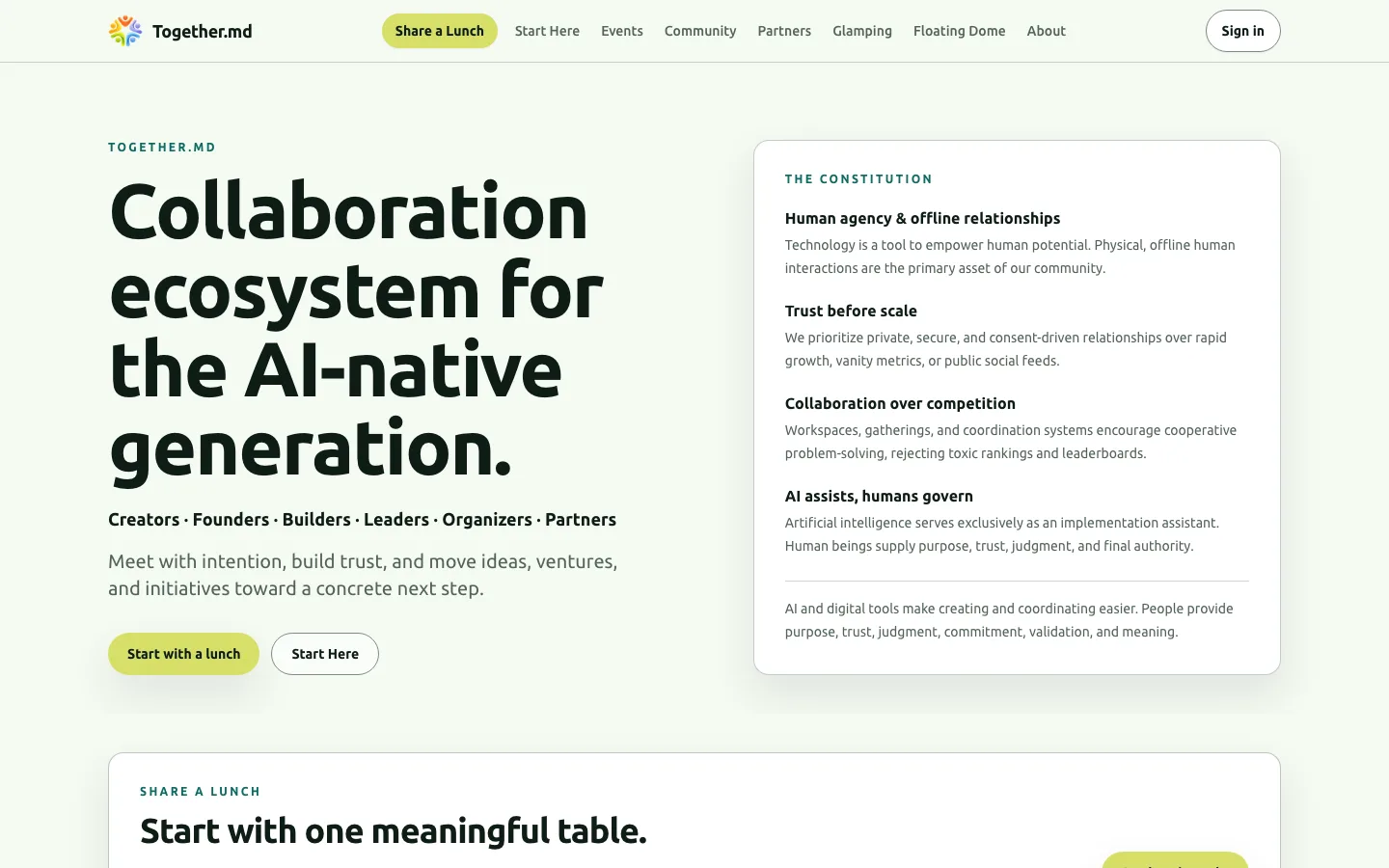
  • The Together.md home page, showing its collaboration-ecosystem headline alongside a panel setting out the ecosystem's constitution.

    Collaboration ecosystem and offline coordination

    Together.md

    A human-first collaboration ecosystem where AI-native creators, founders, builders, leaders, organizers, and partners meet with intention to build trust and move initiatives offline.

    Live coordination ecosystem · ValidatingAs of August 2026

    Proves: Sustained multi-workstream execution with preserved project memory and human approval.
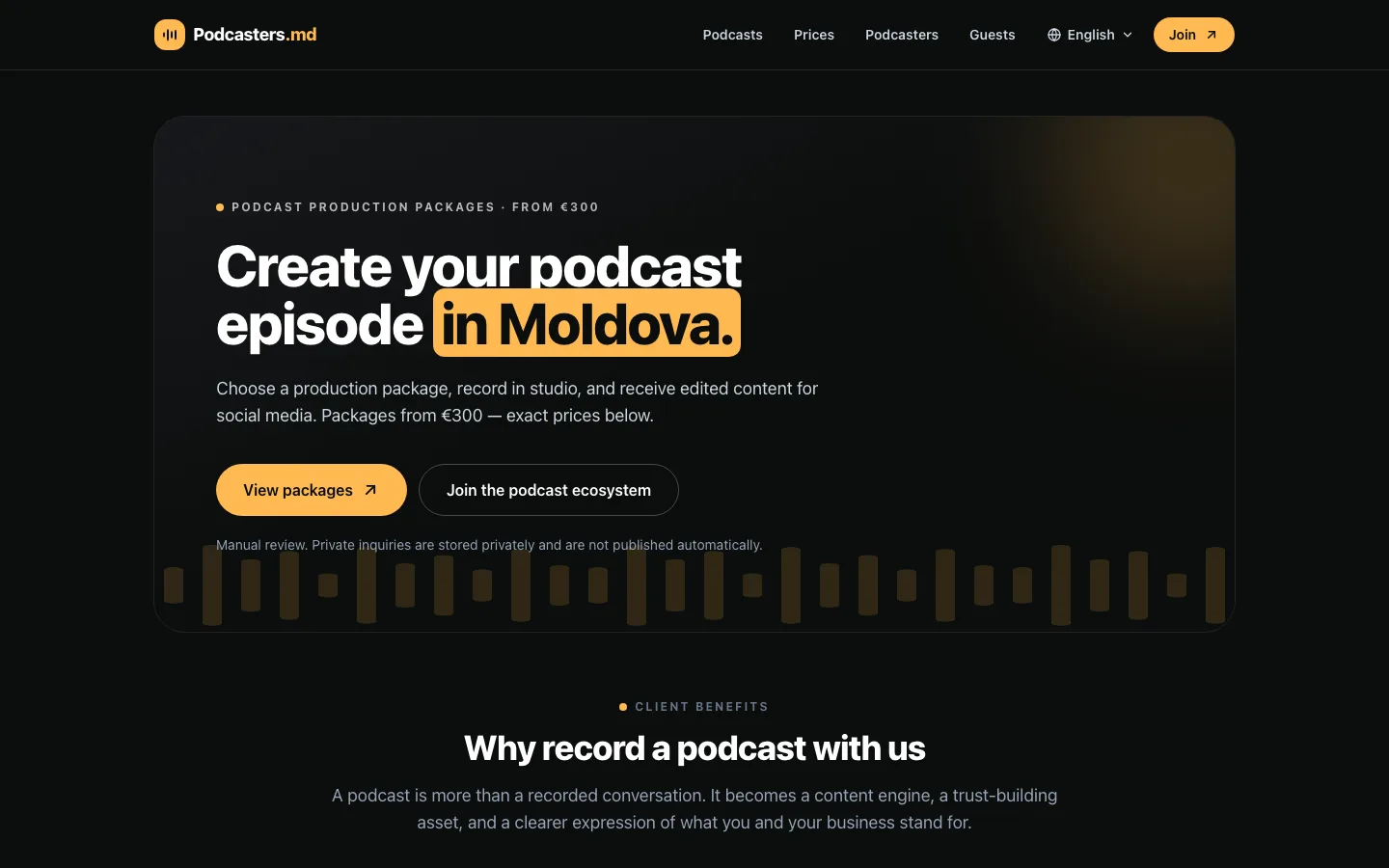
  • The Podcasters.md home page, showing its podcast production headline, package pricing from €300, and calls to view packages or join the ecosystem.

    Media production service and ecosystem directory

    Podcasters.md

    Moldova's podcast ecosystem and production service connecting creators, guests, and businesses through recording packages, directories, and distribution support.

    Live podcast service and ecosystem · ValidatingAs of August 2026

    Proves: A multi-tier live product with public pricing, structured intake, and privacy boundaries.

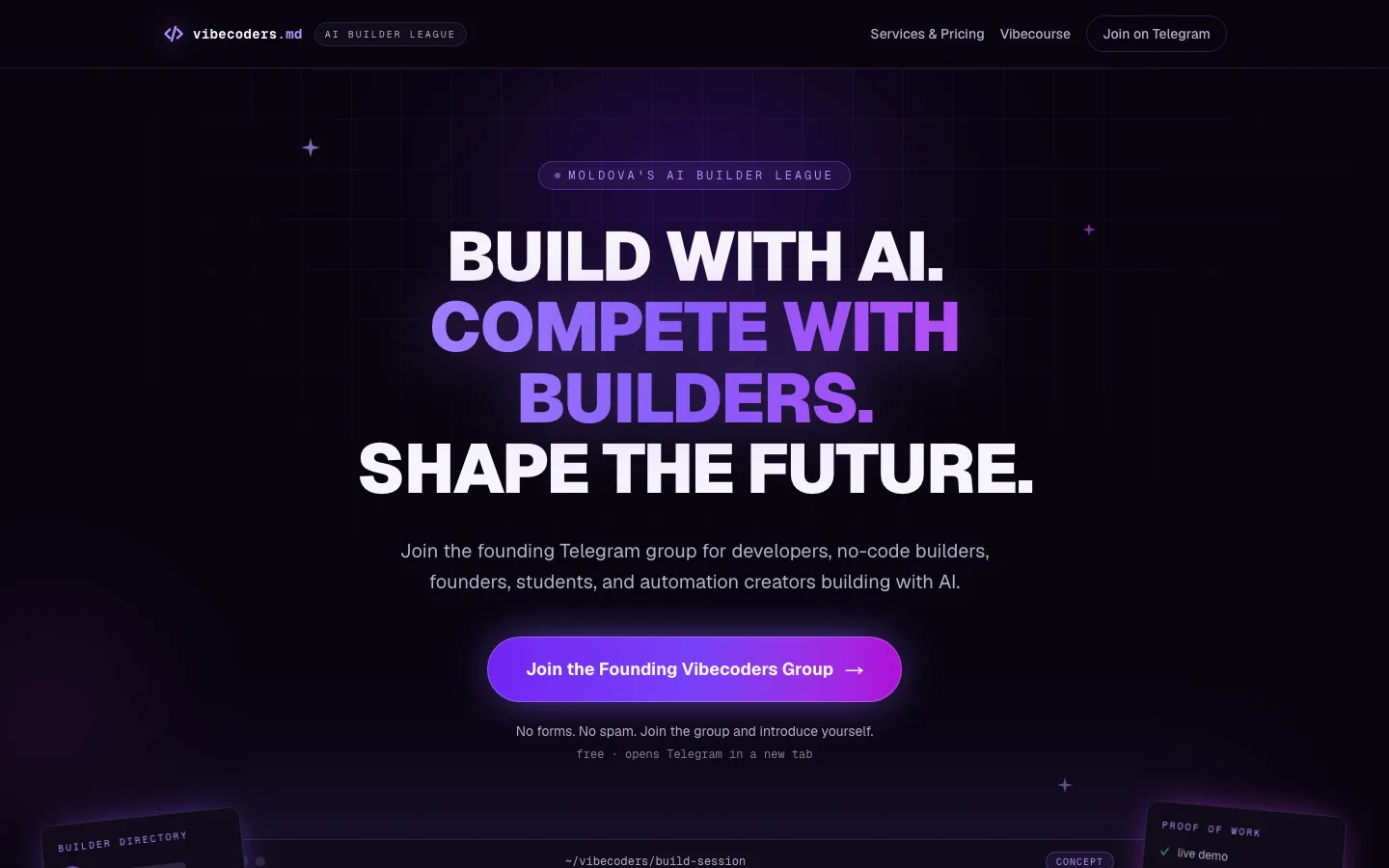
  • The Vibecoders.md home page, showing its build-with-AI headline and an invitation to join the founding Vibecoders group on Telegram.

    AI builder community and educational venture

    Vibecoders.md

    Moldova's AI builder community and educational venture offering hands-on technical services, founder consulting, and a founding Level 1 Vibecourse pilot.

    Live services and community · Founding course pilotAs of August 2026

    Proves: AI-assisted workflows packaged as services, community, an educational funnel, and a supporting assistant.

Why these three

Our ventures are the proving ground.

Together.md, Podcasters.md, and Vibecoders.md are not client references. They are founder-owned ventures, built and operated through the same workflow we run with anyone else. When the operating system has a weakness, it surfaces here first — at our own cost, not a client's.

Together.md, Podcasters.md, and Vibecoders.md demonstrate repeated venture execution. Their business outcomes and validation stages are reported separately.

The problem

AI makes output easier. It does not make coordination automatic.

The bottleneck moved. Producing work is no longer the hard part; deciding what is worth producing, keeping context between sessions, and knowing who reviewed what before it shipped — that is where ventures still fall over.

01

Output is cheap. Decisions are not.

Generating a page, a schema, or a service is fast now. Deciding which one is worth building, and holding someone accountable when it is wrong, is still human work.

02

Context disappears between sessions.

Without written project memory, each session re-derives the same decisions and quietly contradicts the last one. Speed without continuity produces drift.

03

Nothing should approve its own work.

A system that builds and signs off on its own output has no review gate. Independent review and a founder decision are what make the speed usable.

The factory lifecycle

Nine stages, run the same way every time.

The lifecycle is what makes venture execution repeatable rather than heroic. Each stage has an owner, an output, and a point where the founder decides whether it continues.

  1. Stage 01

    Idea

    Start from a single sentence. The concept, the user, and the problem are pressure-tested before anything is designed.

  2. Stage 02

    Venture brief

    Turn the idea into a scoped brief: target user, core problem, the smallest responsible scope, and explicit non-goals.

  3. Stage 03

    Research

    Examine the market, the existing alternatives, and the constraints that will decide whether the thing is worth building at all.

  4. Stage 04

    Architecture

    Define data models, component maps, integrations, and privacy boundaries before consequential implementation begins.

  5. Stage 05

    Build

    Implement against the approved architecture, in narrow and testable increments rather than one large unreviewable change.

  6. Stage 06

    Review

    An independent reviewer audits the implementation. Whoever built the work does not approve it.

  7. Stage 07

    Deploy

    Ship to a real production surface with a recorded deployment report, on the founder's approval rather than automatically.

  8. Stage 08

    Validate

    Launch begins validation. Put the product in front of real people and record what is actually evidenced, separately from what is live.

  9. Stage 09

    Operate

    Keep the venture running: current status, decision history, and project memory maintained so the next cycle does not start from zero.

System anatomy

Five parts, and none of them are optional.

Remove any one of these and the workflow degrades into fast, unaccountable output. Together they are what makes the acceleration safe to use on something you care about.

Specialized roles
Strategy, architecture, implementation, and review are separate responsibilities with separate boundaries, not one general-purpose assistant asked to do everything.
Founder decision gates
Named points where work stops until the founder decides. Scope, architecture, deployment, and public claims are all gated.
Project memory
Decisions, status, and rationale are written down as operational records, so context survives between sessions and between people.
Independent review
Implementation is audited by something other than what produced it, before it reaches production or the public.
Market-validation loop
Shipping is treated as the start of validation. What is live and what is evidenced are tracked as two different things.
Three ways to start

Choose where you are starting.

One idea, your own factory, or a portfolio you already carry. Each mode is a different starting point, not a different tier — and each one states plainly what it does not promise.

  • Venture Build Sprint

    Turn one approved opportunity into the smallest responsible product needed to test it.

    Boundary: An MVP, prototype, validation surface, or internal tool may be produced. A complete startup, users, revenue, distribution, and product-market fit are not guaranteed.

  • Startup Factory Setup

    Install a repeatable human-led multi-agent workflow around your own projects.

    Boundary: This is an operating-system setup, not access to an autonomous-agent subscription.

  • Portfolio Operating System Pilot

    Create shared governance for several ventures or projects without collapsing them into one backlog.

    Boundary: This is a guided pilot, not an existing portfolio-management SaaS product or a substitute for executive ownership.

Who this is for

Creators · Founders · Builders · Leaders · Organizers

The common thread is not a job title. It is that you are accountable for an outcome, you are willing to decide, and you want the work between the decision and the result to hold up.

Creators
You understand an audience deeply and want a real product to put in front of it, not a deck about one.
Founders
You have an opportunity worth testing and want the smallest responsible product that can test it.
Builders
You already build with AI and want the coordination, review, and memory layer that keeps it from drifting.
Leaders
You are accountable for outcomes across a team and need decisions and their rationale to stay legible.
Organizers
You move people and initiatives toward a concrete next step and need the systems around that to hold.

This is not for you if

  • You want an autonomous system that runs a startup while you are not involved.
  • You want a self-service workspace or an agent subscription to log into.
  • You want a guarantee of users, revenue, validation, or a successful outcome.
  • You want work shipped publicly without review, approval, or a record of what was decided.
Human governance

AI accelerates. Humans remain accountable.

Specialized AI roles do the volume work: strategy drafts, architecture, implementation, review passes, documentation, and validation scaffolding. What they do not do is decide. Scope, architecture, deployment, and every public claim pass through a person who carries the consequences of being wrong.

Nothing in this system approves its own work, and nothing ships because it was generated confidently. That constraint is the reason the speed is usable at all.

Start with the work in front of you.

One idea, your own factory, or a portfolio you already carry. Tell us which, and we will talk about the actual next step.